Information
2026/07/21
Information
Exhibition Overview "Reuniting Mahāvairocana: The Two Sculptures Attributed to Unkei, Associated with Kabasaki-dera"
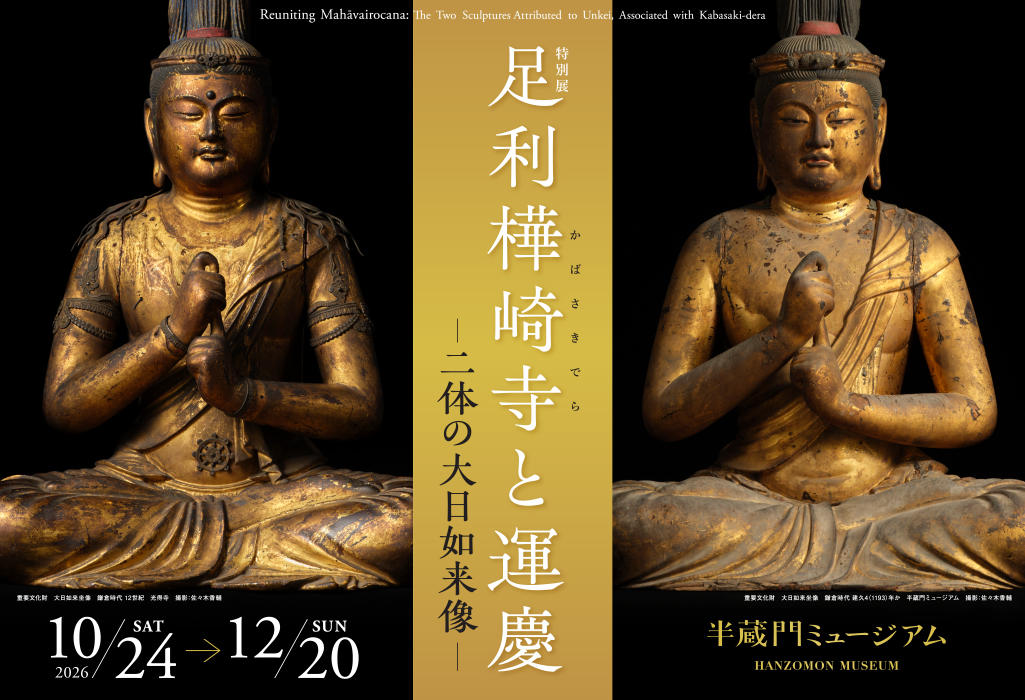
Exhibition Overview
Unkei (d. 1223) is widely regarded as one of Japan's greatest Buddhist sculptors. Research over the past four decades has attributed two previously unrecognized sculptures to Unkei from the height of his career. This exhibition presents their rare reunion outside Kabasaki-dera Temple, the site where they were most likely originally enshrined.
Kabasaki-dera was founded in the early Kamakura period by Ashikaga Yoshikane (d. 1199), a cousin of Minamoto no Yoritomo, founder of the Kamakura shogunate. The second head of the Minamoto-descended Ashikaga clan, Yoshikane was one of the most influential figures in the new military government. He established two nearby temples: Bannaji as the clan temple of the Ashikaga family, and Kabasaki-dera served as its inner sanctuary. Particularly significant are passages in the Founding Account of Bannaji and Kabasaki and Order of Buddhist Ceremonies (Bannaji Kabasaki Engi Butsuji Shidai), which describe two sculptures of Mahāvairocana (Dainichi Nyorai, the Cosmic Buddha) associated with Yoshikane.
One of the two is a fully gilded three-foot-tall Mahāvairocana of the Diamond Realm housed in a zushi (miniature shrine), containing a votive text dated Kenkyu 4 (1193). According to the text, it was enshrined in Shimo no Mido, the main hall of Kabasaki-dera. The Seated Mahāvairocana (Important Cultural Property), which has been on permanent display since the Hanzomon Museum opened, is widely considered to be the very image described in this document.
The second is a Mahāvairocana of the Diamond Realm with the Thirty-seven Deities, enshrined in a zushi measuring 3 shaku 7 sun (approx. 112 cm in height). According to the same text, Ashikaga Yoshikane commissioned the sculpture to commemorate the birth of his son, Yoshiuji (d. 1254), after encountering Rishin, the founding abbot of Bannaji. The Mahāvairocana, an Important Cultural Property also in a zushi and now preserved at Kotokuji in the city of Ashikaga, is thought to be this very sculpture. It was handed down in Akamido ("Red Hall"), Yoshikane's mausoleum at Kabasaki-dera, on the site of the present-day Kabasaki Hachimangu Shrine.
The Ashikaga family later established the Muromachi shogunate, which ruled Japan for nearly two and a half centuries. As the country entered the early modern period, however, Kabasaki-dera declined. Many of its buildings fell into ruin, and the temple site is now preserved as an archaeological site in Kabasaki-cho, Ashikaga, Tochigi Prefecture.
These two sculptures are believed to have been created by Unkei during the Kenkyu era (1190-99), when he was in his forties and at the peak of his artistic powers. This was also the period in which he carved the monumental sculptures for the Great Buddha Hall of Todaiji in Nara and reconstructed the sculptural ensemble originally conceived by Kukai, founder of the Shingon Esoteric Buddhism, for the Lecture Hall of Toji in Kyoto. Displayed together, the two Mahāvairocana images offer a rare opportunity to trace the development of Unkei's artistic style and technical mastery at the pinnacle of his career. The exhibition also invites visitors to discover many facets of his works, including the significance of the dedicatory objects concealed within the sculptures and the religious ideas they embody.
This exhibition goes beyond the reunion of two masterpieces. By bringing together sculptures, historical documents, and archaeological discoveries, it offers a richer understanding of Kabasaki-dera, a major temple founded by the Ashikagas, one of the most influential warrior families of medieval Japan. Highlights include the Founding Account of Bannaji and Kabasaki and Order of Buddhist Ceremonies from the Bannaji Documents (Important Cultural Property) preserved at Bannaji, other rare documents relating to the temple, the Seated Kṣitigarbha (Jizo) from Kotokuji--possibly originating from Kabasaki-dera--and archaeological finds from the temple site.
We wish to express our deepest gratitude to the lenders, the members of the Executive Committee for their dedication to planning the exhibition and editing and writing the catalogue, our co-organizer, The Mainichi Newspapers Co., Ltd., and the many individuals and institutions whose generous support made this exhibition possible.
Exhibition Highlights
The reunion of the two Mahāvairocana sculptures
This is a unique opportunity to experience the two Mahāvairocana sculptures, attributed to Unkei and closely associated with Kabasaki-dera Temple at the Hanzomon Museum.
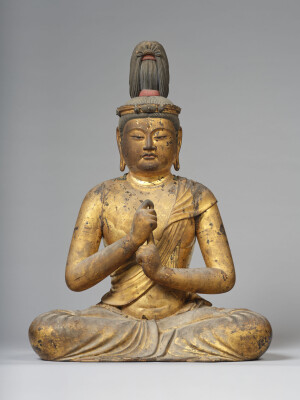
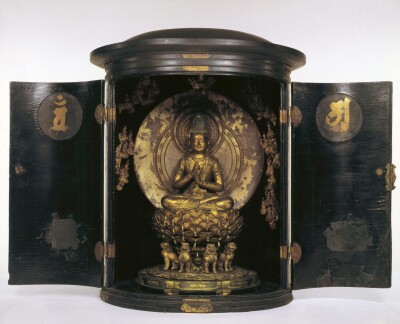
Top: Seated Mahāvairocana (Dainichi Nyorai), Important Cultural Property, Kamakura period, presumably Kenkyu 4 (1193), Hanzomon Museum Photo: Kyosuke Sasaki
Bottom: Seated Mahāvairocana (Dainichi Nyorai) in a zushi (miniature shrine), Important Cultural Property, Kamakura period, 12th century, Kotokuji
The Founding Account of Bannaji and Kabasaki and Order of Buddhist Ceremonies (Bannaji Documents), providing documentary evidence relating to two Mahāvairocana sculptures
Compiled in the 15th century during the Muromachi period, this text forms part of the Bannaji Documents, designated an Important Cultural Property. It preserves inscriptions that are thought to identify each of the two Mahāvairocana sculptures.
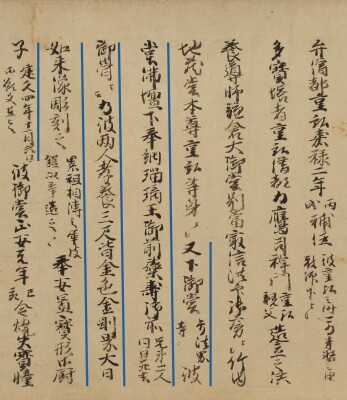
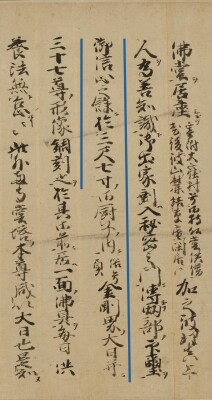
Top: Inscription believed to refer to the Hanzomon Museum's Mahāvairocana sculpture
"The ashes of the siblings Rurio Gozen and Yakuju Gozen, who died on the same day, were interred beneath the hall of Shimo no Mido. A three-foot Mahāvairocana sculpture of the Diamond Realm was created in their memory. The accompanying zushi contained a votive text dated Kenkyu 4 (1193)."
Bottom: Inscription believed to refer to Kotokuji's Mahāvairocana sculpture
"Inspired by his deep devotion, Ashikaga Yoshikane had a Mahāvairocana statue of the Diamond Realm sculpted, accompanied by the Thirty-seven Deities, to be housed in a zushi measuring 3 shaku 7 sun (approx. 112 cm in height)."
Historical documents revealing Kabasaki-dera
Kabasaki-dera (present-day Kabasaki Hachimangu Shrine) appears in the 15th-century (Muromachi period) Illustrated Map of the Bannaji Temple Complex and its Twelve Subtemples.
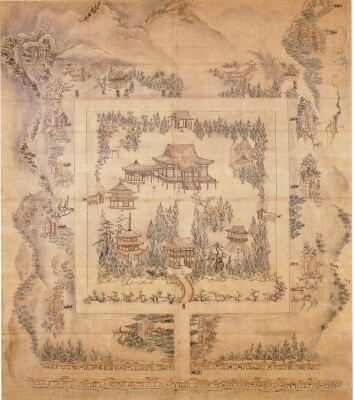
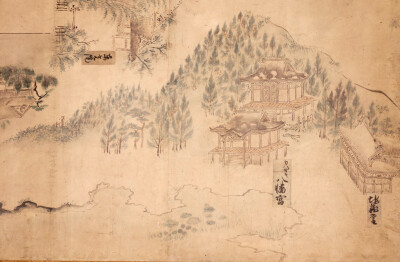
Top: Illustrated Map of the Bannaji Temple Complex and its Twelve Subtemples, Muromachi period, 15th century, Bannaji
Bottom: Enlarged detail from Illustrated Map of the Bannaji Temple Complex and its Twelve Subtemples, Muromachi period, 15th century, Bannaji
Exhibition Background
In 1986, while serving as an assistant curator at the Tokyo National Museum, the Hanzomon Museum's current director, Tsutomu Yamamoto, examined the Mahāvairocana housed in a zushi (miniature shrine) at Kotokuji Temple. Introduced to the sculpture by Keiko Osawa, then a university student and now Professor at Bunsei University of Art, Yamamoto recognized that its form closely corresponded to the "Mahāvairocana in a zushi accompanied by the Thirty-seven Deities" described in the Founding Account of Bannaji and Kabasaki and Order of Buddhist Ceremonies, a historical document associated with Ashikaga Yoshikane. X-radiographs further revealed dedicatory objects remarkably comparable to those found in other sculptures by Unkei. Yamamoto's publication of these findings in 1988 transformed understanding of the sculpture, leading to its designation as an Important Cultural Property and became a landmark contribution to the study of Unkei.
Seventeen years later, in 2003, Yamamoto experienced an unexpected encounter with another seated Mahāvairocana that bore a striking resemblance to the example at Kotokuji. It was difficult to believe that the two sculptures were unrelated. They shared not only their appearance, but also distinctive construction methods, including the uchiguri technique with its raised interior base, identical metal fittings attaching the sculpture to its pedestal, and closely comparable dedicatory objects revealed by X-radiography. The newly discovered sculpture also measured approximately 90 cm in height, matching the "fully gilded three-foot Mahāvairocana" recorded in the Founding Account of Bannaji and Kabasaki and Order of Buddhist Ceremonies. Together, these observations gave rise to the hypothesis that both sculptures had been commissioned by Ashikaga Yoshikane and carved by Unkei.
In 2008, the newly discovered statue was put up for auction in New York, placing it at serious risk of being dispersed overseas. Shinnyo-en acquired the statue as part of its commitment to preserving cultural heritage for future generations, ensuring that it remained in Japan. It was subsequently designated an Important Cultural Property and has been on permanent display at the Hanzomon Museum since its opening in 2018.
The two sculptures may have been preserved at Kabasaki-dera Temple, an inner sanctuary of Bannaji, the clan temple of the Ashikaga family. Kabasaki-dera also served as the site of Ashikaga Yoshikane's mausoleum and as a major center for rites performed for the prosperity of the Ashikagas. Historical records indicate that during the Muromachi period, special services were conducted there on behalf of the shogunal family. Also featured in this exhibition is the Official Directive Bearing the Signature of Ashikaga Takauji dated Bunna 3 (1354), in which Ashikaga Takauji, founder of the Muromachi shogunate, authorizes the chief abbot of Kabasaki-dera to perform "rites for peace and tranquility throughout the realm" and instructs him to continue them with unwavering devotion.
We are deeply grateful to Kotokuji, Bannaji, and many other lenders for generously making their treasured sculptures and historical documents available for this exhibition, as well as to our co-organizer, The Mainichi Newspapers Co., Ltd., and to the City of Ashikaga, the Ashikaga City Board of Education, and The Shimotsuke Shimbun for their invaluable support. Showcasing the fruits of four decades of research on Unkei, this exhibition also offers visitors an exceptional opportunity to discover Kabasaki-dera, the medieval Buddhist temple of the Ashikaga family, who later established the Muromachi shogunate.
【Visitor Information】
Exhibition Title: Reuniting Mahāvairocana
The Two Sculptures Attributed to Unkei, Associated with Kabasaki-dera
Dates: October 24-December 20, 2026
Part I: October 24-November 22, 2026
Part II: November 25-December 20, 2026
Venue: Hanzomon Museum
Address: 25 Ichiban-cho, Chiyoda-ku, Tokyo
Hours: 10:00 am-5:30 pm (last admission 5:00 pm)
Unkei Night: Extended Hours
Fridays, October 30, November 20, and December 18, 2026
10:00 am-8:00 pm (last admission 7:30 pm)
Closed Mondays and Tuesdays; open on November 3
Admission: Free
Co-organized by
Hanzomon Museum and The Mainichi Newspapers Co., Ltd.
With the special cooperation from
Kotokuji (Kandenzan), Myoshinji School of the Rinzai Denomination
Bannaji (Kongosan), Dainichi School of the Shingon Denomination
Supported by
City of Ashikaga, Ashikaga City Board of Education, and The Shimotsuke Shimbun