Information
2025/02/24
Information
Special Exhibition "Attendants in the Buddhist Pantheon"
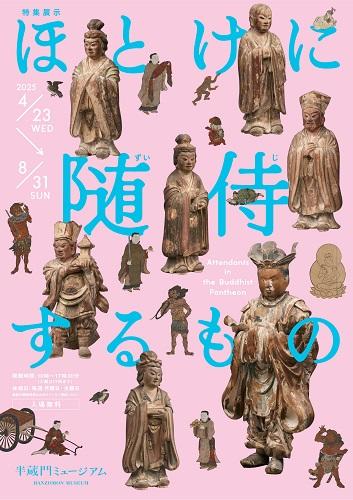
The upcoming Special Exhibition "Attendants in the Buddhist Pantheon" will be on view from April 23 to August 31, 2025.
The focus of this exhibition is on the attendants of the main buddha figures and includes deities flanking the buddha and an entourage of followers and fellows. They are amazingly charming and often very easy to relate to: some show unique poses and others are emotionally expressive.
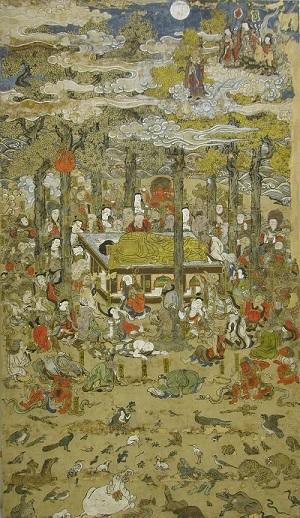
The display starts with the avatars of Avalokiteśvara (Kannon) who appears in thirty-three different ways to guide people: one from the Museum's collection, Standing Brahmā (formerly at Hoyoji Temple), and six from the Yaichi Aizu Collection, Waseda University (formerly at Nyohoji Temple), all of which have been handed down at temples in the Aizu region of Fukushima Prefecture. Examples of attendants are seen in Cundā (Jundei Kannon), Kulika Acalanātha (Kurikara Fudo Myo-o), Sarasvatī (Benzaiten) and her fifteen attendants, and Blue-Faced Vajra Wielder (Shomen Kongo). In Parinirvāṇa of the Buddha (Butsu nehan-zu) and Hie Sanno Juzenji Mandala, animals are found among those following the figure that embodies buddhahood.
Please enjoy a wide array of adorable beings beside the buddhas and deities.
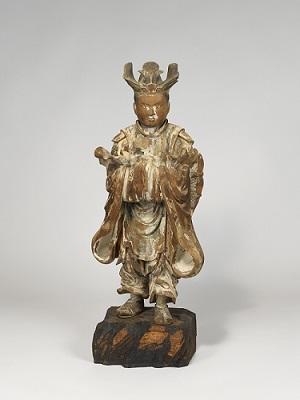
1)
Standing Brahmā. One of the thirty-three avatars of Avalokiteśvara (Kannon Bosatsu)
Muromachi period, ca. Meitoku 5 (1394)
One of the thirty-three manifestations of Avalokiteśvara to guide and help those in pain and suffering, formerly kept at Hoyoji Temple in Fukushima
2)
From the thirty-three avatars of Avalokiteśvara (Kannon Bosatsu)
Northern and Southern Courts period, Shitoku 1 (1384)
Six of the thirty-three manifestations of Avalokiteśvara to guide and help those in pain and suffering, formerly kept at Nyohoji Temple in Fukushima
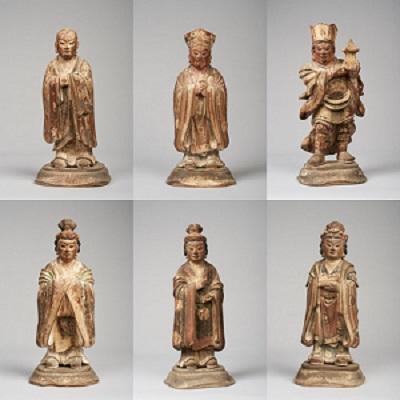
From the Yasushi Mori Collection, Waseda University Aizu Museum, photographed by Kyosuke Sasaki
3)
Blue-Faced Vajra Wielder (Shomen Kongo)
Muromachi period, 16th century
The five directions are in control by the Blue-Faced Vajra Wielder and the four fellow fierce deities; painting used to pray for curing sickness.

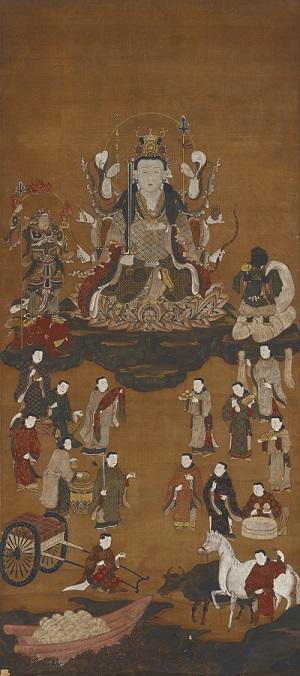
4)
Sarasvatī (Benzaiten) and her fifteen attendants
Edo period, 18th century
The attendants with rice, cow and horse, and other items symbolizing nature's bounty accompany Sarasvatī, a female deity of happiness and prosperity.
5)
Parinirvāṇa of the Buddha (Butsu nehan-zu)
Edo period, 18-19th century
In the Buddha Śākyamuni's final moments, his disciples, deities, lay practitioners, and animals gather in grief.
6)
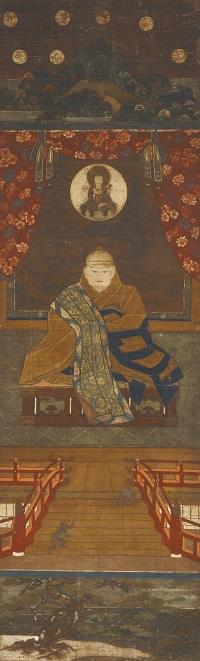
Hie Sanno Juzenji Mandala
Kamakura period, 14th century
Portrayed are the principal deity of the Juzenji shrine and a divine messenger monkey. Juzenji is in the shrine complex of Hiyoshi Taisha at the foot of Mt. Hiei.
Specially on view will be the Mandala of the Two Realms produced based on the original mandala brought to Japan from China by Master Kukai, the founder of Shingon Esoteric Buddhism, in the 9th century. The intricate details of buddhas and deities in vibrant colors and kirikane, a technique that employs gold leaf cut into thin strips to form patterns, are quite stunning. Standing before this exceptional mandala over two meters high can be an immersive and inspiring experience.
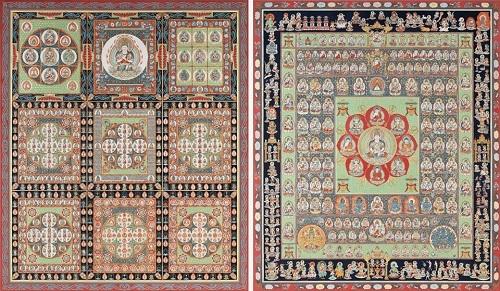
Mandala of the Two Realms
Reiwa 6 (2024)